
What is Local SEO for Home Service Businesses?
Local SEO is the process of optimising your online presence so your home service business appears when nearby customers search for services like yours on Google.
When a homeowner in Dallas, TX types "emergency plumber near me" into Google, three local businesses appear in a map — that's the Google Local Pack, and it's where most calls come from. Local SEO is what gets you into that map.
Unlike traditional SEO — which targets a broad national audience — local SEO for home service businesses is hyper-focused on the specific neighbourhoods, towns, or cities you actually serve. It's about showing up for the right people, in the right place, at exactly the right moment.
Who Needs Local SEO?
- Plumbers, electricians & HVAC contractors
- Cleaning, landscaping & gardening services
- Pest control, roofing & window companies
- Handymen, locksmiths & appliance repair businesses
- Any trades or home service business with a defined service area
The strategies in this guide require time and effort — not a large budget. Google's core local ranking tools (Google Business Profile, Maps, Search Console) are all completely free. You can start today with zero ad spend.

Why Local SEO Matters More Than Ever in 2026
At 8:14 pm, a homeowner's heating goes out. They don't read blogs. They don't compare ten websites. They tap the map, skim three reviews, and call. That job is won or lost in under 60 seconds.
Google's AI systems now filter local results faster and more aggressively than ever. If your Google Business Profile is weak, your service areas are unclear, or your website sends mixed signals — you are invisible at the exact moment your customer is ready to buy.
The Numbers Don't Lie
46% of All Google Searches
Nearly half of all Google searches have local intent — someone looking for a business or service near them.
76% of Local Searches = Visit or Call
76% of people who search for something nearby on their smartphone visit or contact a business within 24 hours.
The Map Pack Drives Calls
The Google Map Pack (top 3 local results) receives the majority of clicks for home service searches — organic listings barely get a look in.
A strong free local SEO for small business strategy enables you to compete directly with larger companies — and win — purely by being more visible and more trustworthy in your local area.
Key Local SEO Ranking Factors for Home Services
Google uses a blend of signals to decide which businesses appear in local results. Understanding these factors is the foundation of any successful local SEO home service business strategy.
| Ranking Factor | Weight (2026) | Strength |
|---|---|---|
| Google Business Profile Signals | ~32% | |
| On-Page / Website Signals | ~16% | |
| Review Signals | ~16% | |
| Link / Citation Signals | ~11% | |
| Behavioural Signals | ~9% | |
| Citation / NAP Consistency | ~7% | |
| Personalisation Signals | ~6% |
Source: Whitespark Local Search Ranking Factors 2026
Google Business Profile signals alone account for nearly a third of your ranking power. If you do nothing else, optimising your GBP is the single highest-return action you can take — and it's completely free.
Google Business Profile — Your Most Powerful Free Tool
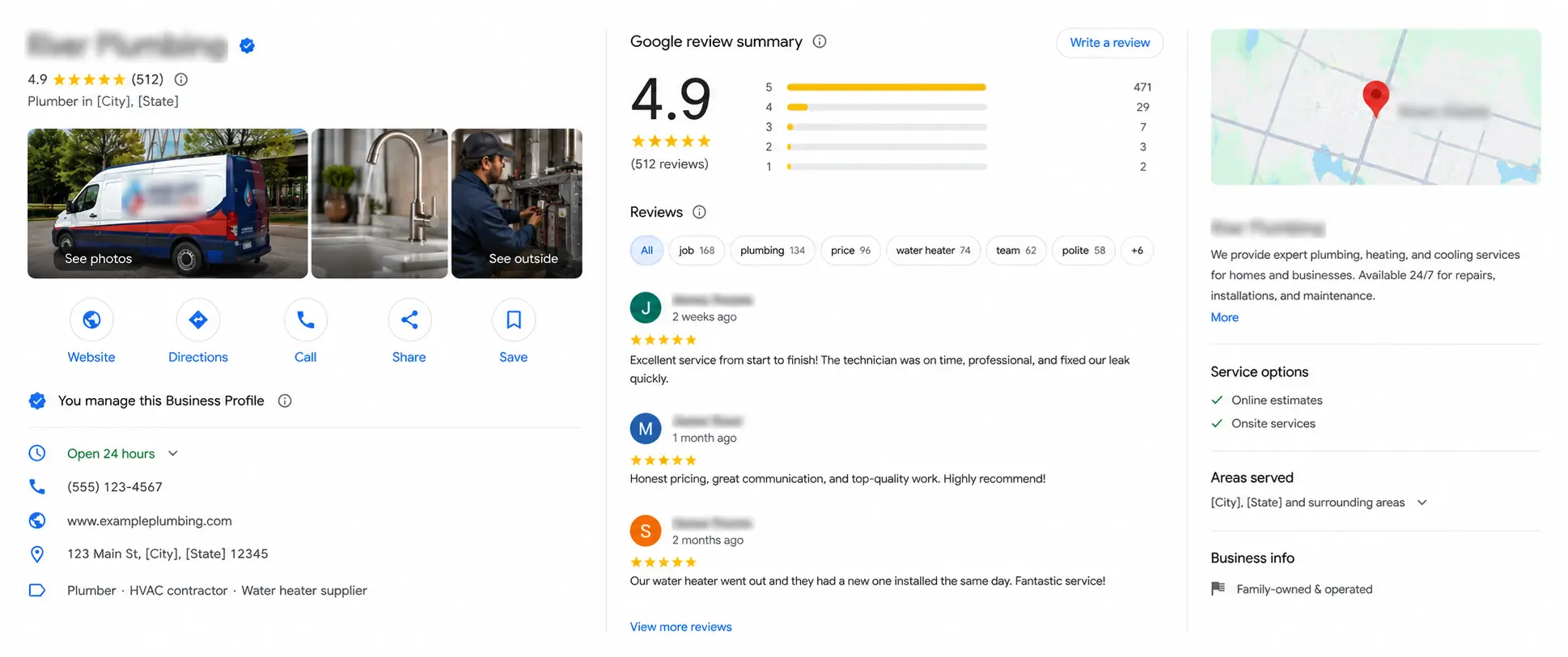
Your Google Business Profile (GBP) is the first thing Google inspects before deciding whether to show your business. Before your website. Before your ads. Before anything else.
A poorly set-up GBP means Google quietly limits your visibility — and you'll never get a warning. Here's exactly how to optimise it.
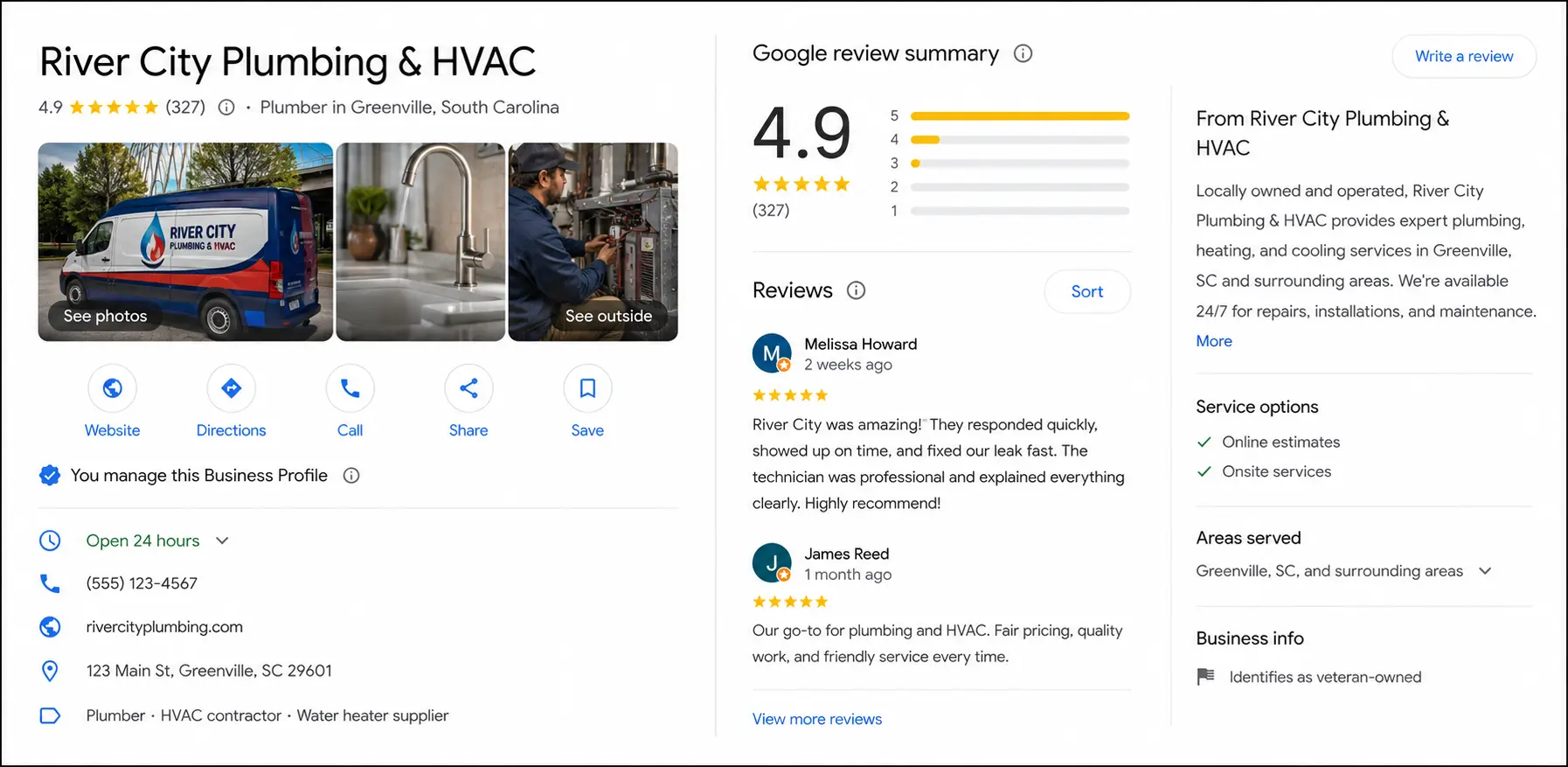
Step-by-Step GBP Optimisation Checklist
-
1Claim & Verify Your Listing — Go to business.google.com and complete the postcard or phone verification. An unverified profile has severely limited visibility.
-
2Choose the Right Primary Category — This is a gatekeeper, not a detail. "HVAC Contractor" and "Heating Contractor" are different — the wrong one hides you from half your potential customers. Pick the one that best defines your core service.
-
3Write a Detailed Business Description (750 chars) — Include your primary services, your service area, and what makes you different. Use natural language and include your most important keyword once.
-
4List Your Services Accurately — Don't list everything imaginable. List the specific services people actually call you for: "Emergency boiler repair," "Same-day drain clearing," "24-hour electrician." Services = confirmations, not keywords.
-
5Upload High-Quality Photos Regularly — Photos of your branded vehicles, team in uniform, and completed jobs. Google measures photo interaction — listings with fresh, real photos get more engagement and rank higher.
-
6Post Regular Updates — Seasonal offers, recent jobs, and team news. Generic posts get ignored. Only post when you have something real to share.
-
7Set Accurate Business Hours — Including special hours for bank holidays. Incorrect hours lose you calls and damage trust.
Real-World Examples by Region
HVAC Contractor
An AC repair business in Houston uses "HVAC Contractor" as primary category, uploads photos weekly of completed jobs in local neighbourhoods, and requests reviews mentioning specific areas like "The Woodlands" and "Sugar Land."
Search: "AC repair The Woodlands TX"Emergency Plumber
A plumber in Manchester lists "Emergency Plumber" and "Boiler Repair" as services (not just "Plumbing"). Their description mentions "serving Salford, Chorlton, and Didsbury" — giving Google clear geographic signals.
Search: "emergency plumber Chorlton"Home Cleaning Service
A Dubai cleaning company lists their GBP in both English and Arabic, sets their service area to specific districts (JBR, Marina, Downtown), and replies to every Google review — boosting both trust and engagement signals.
Search: "home cleaning service Dubai Marina"NAP Consistency — The Trust Signal Most Businesses Ignore
NAP stands for Name, Address, and Phone Number. Google cross-checks your business details across the entire web. Even tiny inconsistencies quietly damage your rankings.
If your GBP says "123 Main Street" but your website says "123 Main St." and Yelp says a different phone number — Google reads this as instability. Not a big deal alone, but combined? It filters you out.
Where Your NAP Must Be Consistent
- Google Business Profile
- Your website (header, footer, contact page)
- Yelp, Bing Places, Apple Maps
- Industry directories (Checkatrade in the UK, HomeAdvisor in the US, ServiceMarket in the UAE)
- Social media profiles (Facebook, Instagram, LinkedIn)
- Local chamber of commerce & business association listings
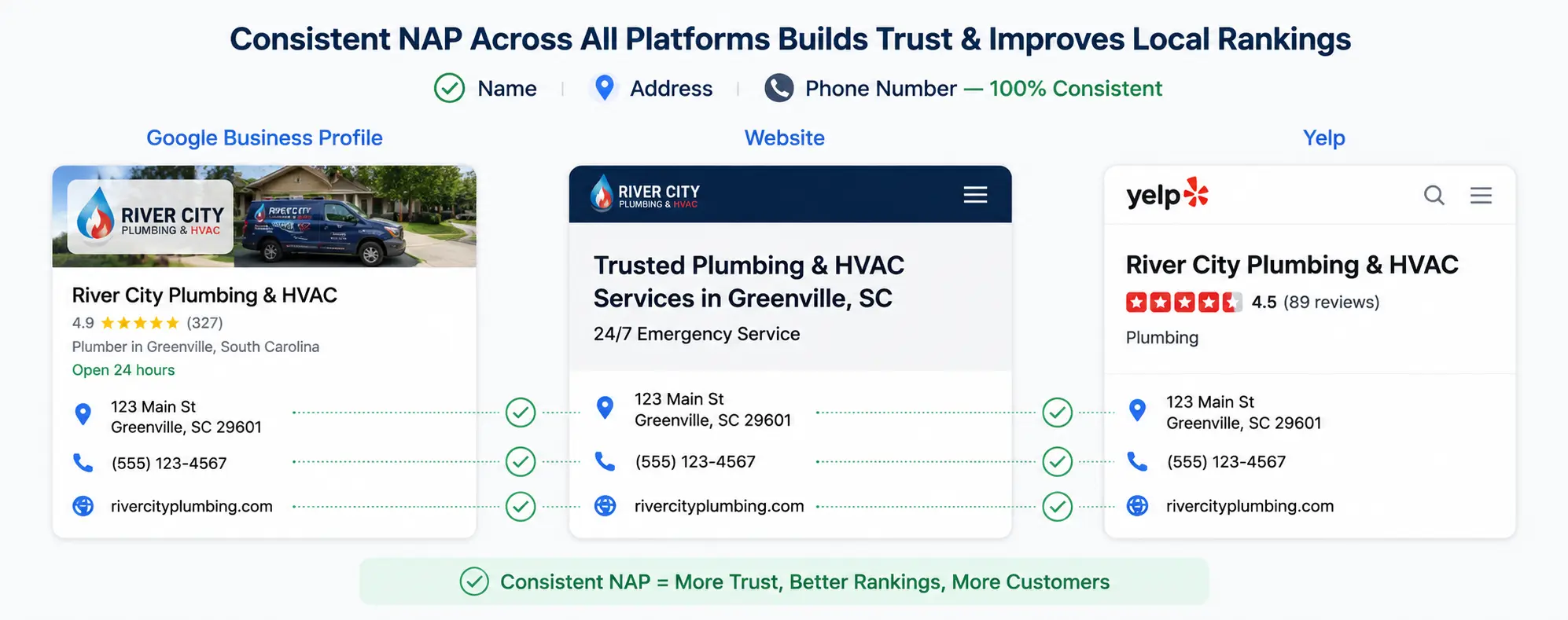
Many home service businesses use a personal mobile number on their website but a landline on their GBP — or they move premises and update one directory but forget others. Do a quarterly NAP audit using free tools like BrightLocal's Citation Tracker or Whitespark.
Reviews & Online Reputation — Trust Before Rankings
Reviews are no longer just testimonials. In 2026, Google uses them as behavioural proof. It looks at what reviews say, when they were written, and how people interact with your listing after reading them.
Ten recent reviews that mention "same-day boiler repair in Leeds" will outperform fifty old five-star reviews that say nothing specific. Recency, specificity, and patterns matter more than star count.
How to Build a Review System That Works
-
1Ask after every job — Send a follow-up text or WhatsApp message 2–4 hours after completing a service, with a direct link to your Google review page.
-
2Make it effortless — Use a short URL or QR code on your invoice or van. The fewer clicks between job completion and leaving a review, the more reviews you'll get.
-
3Respond to every review — Both positive and negative. Thank customers by name, mention the service you did and the location. This also boosts local keyword signals naturally.
-
4Never buy fake reviews — Google detects and removes them. A suspension can wipe out years of visibility overnight. It's not worth it.
Review Examples by Region
HVAC Company
A Phoenix AC company trains every technician to ask for a review and mention the specific neighbourhood. Their reviews now mention "Scottsdale," "Tempe," and "Mesa" — boosting relevance for those area searches.
Electrical Contractor
An electrician in Birmingham includes a review request card with every job sheet. Within 6 months, they went from 8 reviews to 94 — with specific mentions of "Harborne," "Moseley," and "Edgbaston."
Pest Control Service
An Abu Dhabi pest control business responds to reviews in both English and Arabic. Their bilingual responses and consistent mention of "Al Reem Island" and "Khalidiyah" significantly improved local pack visibility.
Local Content & Service Area Pages
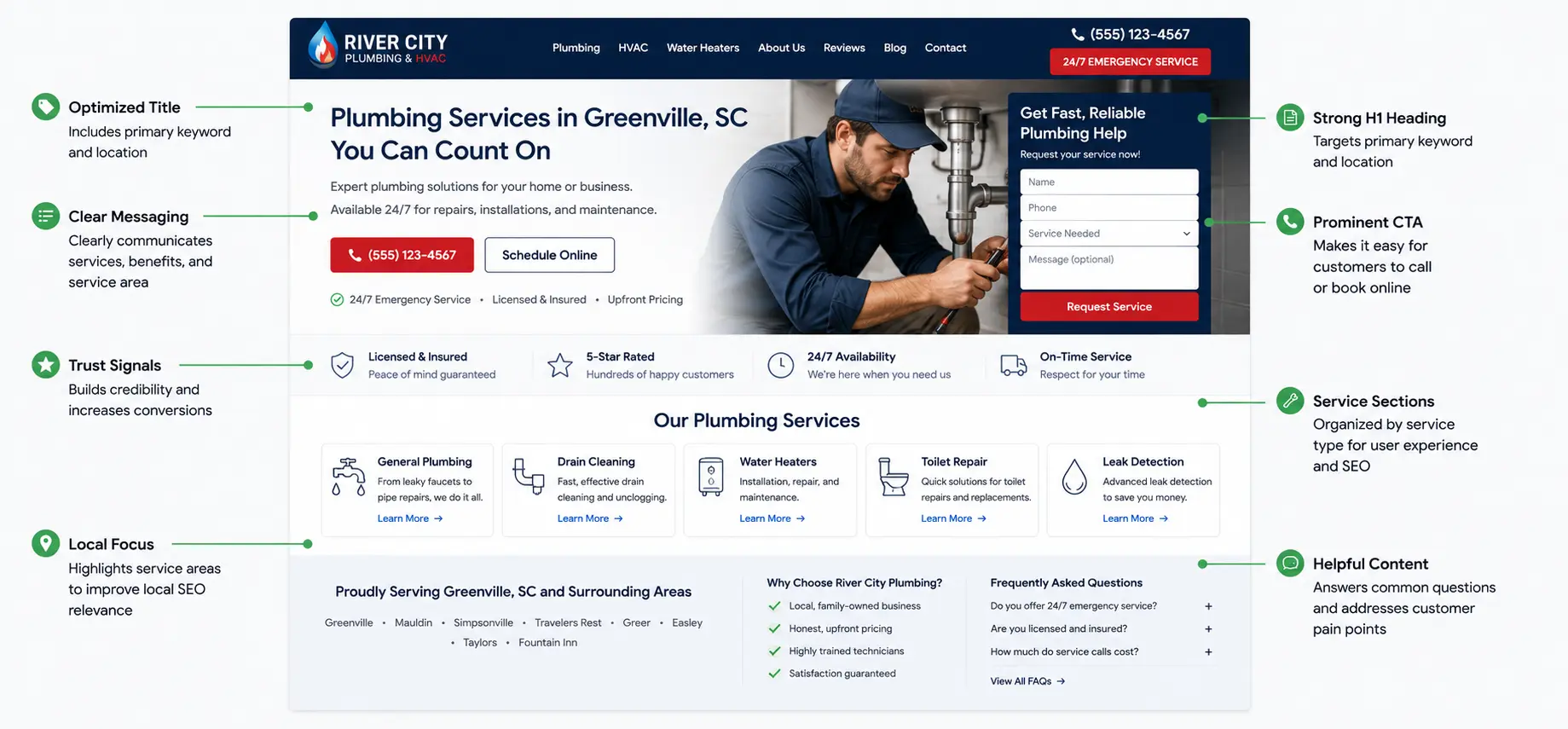
The biggest content mistake home service businesses make is having one generic "Services" page. To rank across multiple suburbs or cities, you need dedicated, hyper-local pages for each combination of service and location.
A page titled "Same-Day Furnace Repair in Gilbert, AZ" will consistently outperform ten generic blog posts about HVAC tips. Google knows exactly when to surface it — and homeowners know exactly why to click it.
How to Build High-Converting Service Area Pages
-
1Target "Service + Location" combinations — e.g. "Drain Cleaning in [City]", "24-Hour Electrician [Suburb]", "Roof Repair [Neighbourhood]"
-
2Use the city name in H1 and H2 headings — Don't bury it in the body text. Make the location signal clear from the top.
-
3Write unique content for each page — Never copy-paste between city pages. Google detects duplicate content and may penalise thin pages.
-
4Mention local landmarks and neighbourhoods — "Serving homeowners near Trafford Park," "covering properties around Palm Jumeirah" — these anchor your page to the location authentically.
-
5Embed a Google Map of your service area — This reinforces your local presence for both users and search engines.
-
6Add local social proof — Include 1–2 reviews or testimonials specifically from customers in that area on each page.
Content Strategy: What Actually Works vs. What Doesn't
High-Intent Local Content
Dedicated service + location pages. FAQ pages answering "How much does boiler repair cost in [City]?" — these match buying intent and convert to calls.
Generic Blog Posts
Weekly "5 tips for homeowners" posts with no local tie-in. These dilute your site's authority and confuse Google about your primary service areas.
Technical SEO Foundations — Speed, Mobile & Schema
A homeowner in an emergency won't wait for a slow website to load. If your site takes more than 3 seconds to display, they click back and call your competitor. Technical health is the foundation everything else is built on.
Mobile-First is Non-Negotiable
Most home service leads are generated on mobile devices — someone standing in their kitchen looking at a leaking pipe. If your "Call Now" button is hard to find or your text is tiny, you lose the lead before it even starts.
Technical Checklist for Home Service Websites
- Mobile-First Design — All buttons must be thumb-friendly. Test on a real mobile phone, not just a browser simulator.
- Page Speed Under 3 Seconds — Compress all images, enable browser caching, and use a fast hosting provider. Use Google PageSpeed Insights (free) to check.
- Click-to-Call Button — Your phone number must be tappable at the very top of every mobile page. Don't make customers hunt for it.
- HTTPS Secure Connection — Non-negotiable. Customers won't trust a site that shows "Not Secure" when they're entering their address.
- LocalBusiness Schema Markup — This structured data tells Google exactly what you do, where you do it, and your operating hours. It helps you appear in rich results and AI summaries.
- Core Web Vitals — Aim for LCP under 2.5s, INP under 200ms, and CLS under 0.1. These are Google's official UX quality scores.
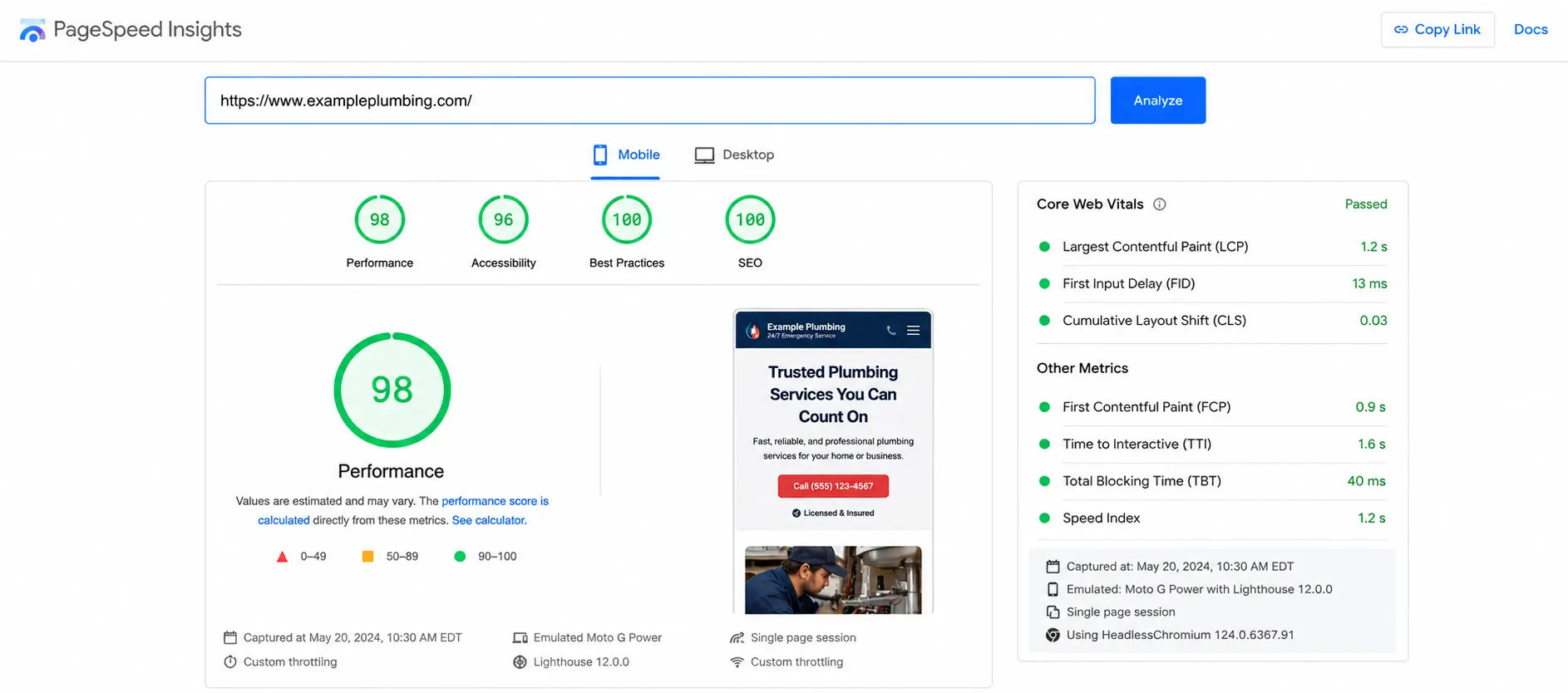
Schema Markup: Clarity, Not Cleverness
Schema is simply structured data that tells Google in plain machine language: what you do, where you do it, and how to categorise you. For home service businesses, the most important schema types are:
- LocalBusiness (and sub-types like Plumber, Electrician, HVACBusiness)
- Service — listing each individual service you offer
- FAQPage — for your FAQ section, which can appear directly in Google results
- Review / AggregateRating — to display star ratings in search results
5 Free Local SEO Strategies to Grow Your Home Service Business
These are the most impactful strategies available to small business owners right now — all achievable without a large agency budget.
Hyper-Localised Content for Voice Search
Voice searches are highly conversational and location-specific: "Who is the best plumber near me available today?" or "emergency electrician open now in [area]." Your content needs to mirror how real people speak.
- Target long-tail keywords that mirror natural speech: "best-rated HVAC engineer in Sharjah today" or "24-hour drain unblocking service near Liverpool"
- Add FAQs to service pages that answer common spoken questions — e.g. "How quickly can you get to me for an emergency?" or "Do you cover [neighbourhood]?"
- Keep sentences short and answers direct — voice assistants pull from content that gives a clear answer fast
"Top-rated electrician near me now" — a Miami electrician added this as a natural FAQ and began appearing in voice search results within 8 weeks.
"Emergency boiler repair Bradford open now" — a Yorkshire heating engineer created a dedicated emergency page targeting this exact query and doubled call volume in 3 months.
Use AI Tools to Improve Customer Engagement
AI-powered chatbots and tools can dramatically improve your local search performance — especially for home service businesses that can't always answer the phone on-site. When a homeowner gets an instant response via chat, they're far more likely to book rather than move to the next company on Google.
- Add a simple chatbot to your website (free tiers available on HubSpot, Tidio, or Intercom) to answer common questions 24/7
- Use AI tools to analyse which of your services are trending locally in search — tools like Google Trends, SE Ranking, or even free keyword planners
- Better engagement = more time on site = stronger behavioural signals = better rankings. It's a direct loop.
A Dubai cleaning service added a WhatsApp chatbot (standard in the UAE market) to their GBP and website. Response rates jumped to under 2 minutes, leading to a 40% increase in conversions from local search traffic.
Video Marketing for Local Engagement
Video has become one of the most powerful free tools for home service local SEO — and most competitors aren't using it. Real job videos build trust faster than any written copy.
- Film short 60–90 second "job highlight" videos showing a completed project in a specific neighbourhood (with the customer's permission)
- Upload to YouTube with a title like "Boiler Replacement in Didsbury, Manchester — Same Day Service" — include the location keyword naturally
- Add videos to your Google Business Profile — Google values multimedia and active listings rank higher
- Share on Facebook and Instagram targeting your local area using geo-targeted posts
Optimise for Zero-Click & Featured Snippets
Nearly 65% of Google searches now end without a click (SparkToro data). This means Google displays the answer directly on the results page — as a featured snippet, People Also Ask box, or local knowledge panel. You want YOUR business to be that answer.
- Structure service pages with clear headings and bullet points — Google loves scannable, direct answers
- Add FAQ sections answering questions like: "How much does a new boiler cost in Birmingham?" or "What's the average cost of AC service in Dubai?"
- Use numbered lists for process-based content — e.g. "5 Signs You Need a New Water Heater"
Zero-click optimisation is about clarity, not keyword density. Google wants the clearest, most direct answer. Padding your content with keywords works against you here.
Build Local Authority with Community Backlinks
A link from the local parish council, a neighbourhood blog, or a small business association carries far more local SEO weight than a generic directory link. Community backlinks confirm both your geography and your legitimacy to Google simultaneously.
- Sponsor a local school, sports team, or charity event — and ask for a link on their website
- Partner with complementary local businesses (a plumber and a kitchen fitter, for example) to cross-link each other's websites
- Contribute articles to local neighbourhood blogs, community Facebook groups, or local news sites
- Register with your local Chamber of Commerce, Federation of Small Businesses (UK), or equivalent business association
A pest control company in Chicago sponsored a Little League team. The school website link and local news coverage gave them two high-quality local backlinks that boosted Map Pack rankings within 60 days.
A Bristol landscaping company partnered with a local garden centre for a cross-referral link exchange. Both saw measurable ranking improvements within 3 months with zero ad spend.
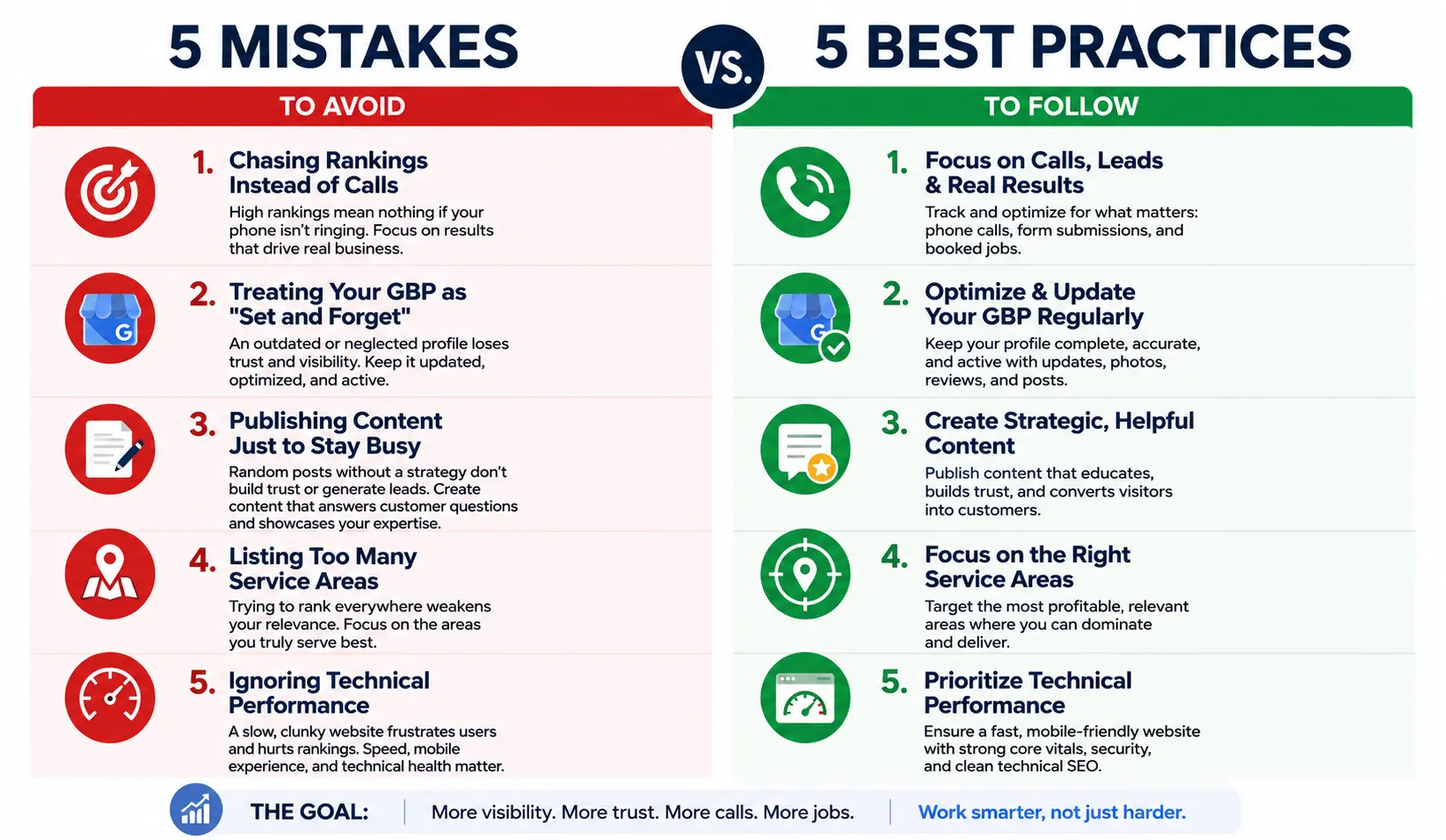
Common Local SEO Mistakes That Quietly Kill Revenue
Most local SEO failures don't look like failure at first. Rankings shift just enough to seem promising. Then the phone stays quiet. Here are the mistakes we see most often.
❌ Chasing Rankings Instead of Calls
Ranking screenshots don't pay payroll. Many businesses rank well for search terms that never lead to a booked job. Your goal is calls and bookings — not position tracking for its own sake. Focus on the right keywords: service + location + intent queries that a homeowner with a real problem would type.
❌ Treating Your GBP as "Set and Forget"
Your Google Business Profile decays without maintenance. Categories drift. Services stop reflecting what you offer. Reviews slow down. Google notices long before you do. Commit to at least one review request per week and one profile update per month.
❌ Publishing Content Just to Stay Busy
A blog post about "5 tips for homeowners in winter" with no location, no service tie-in, and no genuine intent match does nothing for local SEO. It dilutes your focus and confuses Google about what your site is actually about. Only publish content when it serves a real local search query.
❌ Listing Too Many Service Areas
Claiming to serve 25 cities when your reviews, content, and backlinks only reference 2 is a credibility issue in Google's eyes. Start with your core service area, dominate it, then expand with proof (reviews, content, links) for each new area you add.
❌ Ignoring Technical Performance
A visually impressive website that loads in 6 seconds on mobile will lose to a simpler site that loads in 1.8 seconds. Speed is not a "nice to have" — it directly determines whether you keep the lead or lose it to whoever loads next.
Realistic Local SEO Timeline — What to Expect & When
If any agency promises you page-one results in 2 weeks, that's not confidence — that's a warning sign. Local SEO works on momentum, not switches. Here's what a realistic timeline looks like when done properly.
Cleaning Signals — Visibility Before Volume
This phase is about foundations: verifying your GBP, fixing NAP consistency, building service area pages, and getting your first 10–15 reviews. You'll see GBP impressions rise and profile views increase. Phone calls may still be low — that's normal. Don't panic.
Trust Building — Rankings Start Converting
Once Google sees consistent signals, things shift. Non-branded searches start driving calls. Map Pack visibility expands to nearby areas. Review quality improves. Lead quality increases even if volume is modest. This is when most small business owners get impatient and make the mistake of stopping. Don't.
Compounding Advantage — Consistent Call Volume
This is where local SEO earns its reputation. Calls arrive steadily rather than sporadically. New service and location pages rank faster. Your competitors struggle to displace you. You are no longer fighting for attention — you are defending it. This is the stage most businesses never reach because they gave up in month 4.
Market Dominance — Lower Cost Per Lead
At this point, your cost per lead from organic local search is a fraction of what you pay for paid ads. Every new review, every new page, every new backlink compounds on what's already there. The businesses that reach this stage protect their rankings fiercely — because it took discipline to build.
Want Us to Do This For You?
Our team helps small home service businesses rank in the Google Map Pack and generate consistent leads — without guesswork. Transparent pricing, no long-term lock-in.
Frequently Asked Questions — Local SEO for Home Services
Ready to Dominate Local Search in Your Area?
Stop letting competitors take the calls that should be yours. Use this guide to start building your local SEO presence today — or let our expert team handle it for you.
Want to optimize your organic visibility?
We offer free local SEO audits and digital marketing assessments for local service businesses. Speak with our experts.